
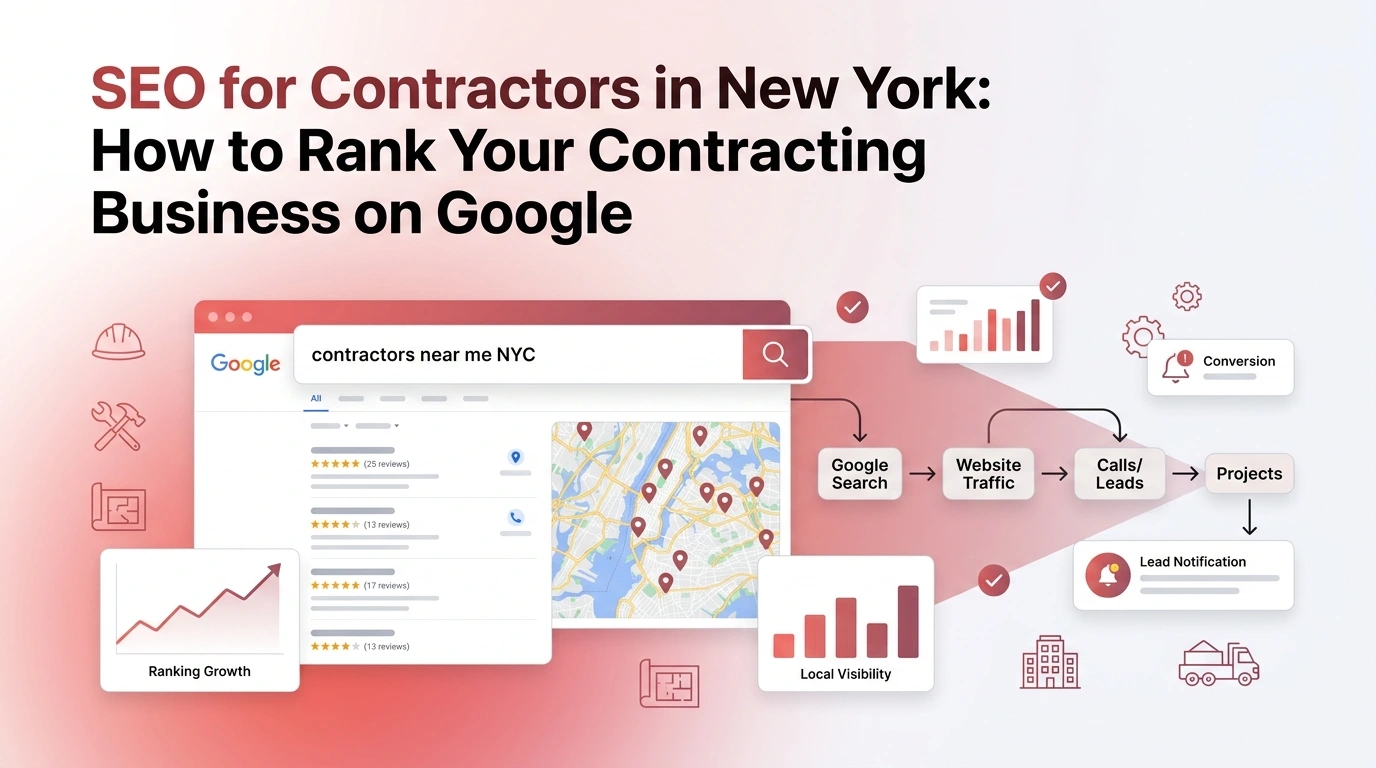
Introduction: Why SEO Controls Your Lead Flow
SEO for Contractors is the process of improving your visibility on Google so local customers can find and contact your business. It is the core system that determines if your business grows or gets stuck. Without it, you are forced to depend on word-of-mouth referrals and offline networking. While those are good, they are not predictable.
Today, almost every customer starts their journey on Google. Whether they need a new roof, an electrician, or a kitchen remodel, they “search” before they “call.” This means that your visibility in search results directly controls how many new jobs you get. If you aren’t on the first page, you effectively don’t exist to these customers.
Many contractors misunderstand how SEO works. It is not just about having a website or posting a blog now and then. Google evaluates your business based on how well you show three things: local relevance, service expertise, and trust. SEO for Contractors is a system made of three layers: visibility, trust, and conversions. If even one layer is weak, the entire system fails. Understanding this is the first step toward long-term business growth.
Why Most Contractors Fail to Get Leads (Even With a Website)
Most contractors fail at SEO not because the competition is too high, but because their digital presence sends the wrong signals. Simply “having a website” is not enough to win, especially when competing for SEO for Contractors in New York. Google does not rank websites just because they exist; it ranks them based on clarity, authority, and how users behave when they visit.
A common mistake is targeting the wrong keywords. Many contractors build generic pages that do not match what a customer actually wants. Instead of focusing on urgent searches like “emergency contractor near me” or “roof repair in New York,” they focus on broad topics. This might bring visitors to the site, but it won’t make the phone ring. They get clicks, but no calls.
Another major issue is a weak local SEO structure. If your Google Business Profile is not optimized, or if your business information is different on different websites, Google won’t trust you. Without consistent data, Google cannot confidently put you in front of local customers looking for SEO for Contractors in New York. In most cases, failing to rank is simply a matter of missing these vital SEO signals.
Visibility vs. Intent Mismatch: The Hidden Reason Leads Don’t Convert
A huge mistake in SEO for Contractors is focusing on “visibility” instead of “intent.” Being seen is useless if the person seeing you isn’t ready to buy. For example, ranking for a general topic like “how to paint a door” might bring traffic, but those people are looking for a DIY tip, not a pro contractor.
The most valuable searches are based on service and urgency. When someone types “roof leak repair near me,” they have a problem that needs a fix right now. Websites that fail to target these high-intent searches will always struggle to find leads. They might have a lot of traffic, but they have no customers.
This is where strategies usually break down. Contractors often optimize for “search volume” (how many people look for a word) instead of “search intent” (why they are looking). High volume doesn’t always mean high profit. To grow, your visibility must translate into phone calls.
Weak Local SEO Signals: Why Google Doesn’t Trust Your Business
Local SEO signals are the most important ranking factors for any local business. Google needs to be 100% sure that your business is real, active, and located where you say it is. If Google doubts your location, your website will stay hidden.
Many contractors struggle because their Google Business Profile (GBP) is empty or inactive. Others fail to keep their Name, Address, and Phone number (NAP) the same across the internet. Even a small difference, like “Street” vs. “St.”, can confuse Google’s system.
When these signals are weak, Google will not put you in the Map Pack. The Map Pack is the box at the top of Google results that shows three local businesses. This area is where most local leads come from. If your local signals are poor, your competitors will outrank you even if their website is worse than yours.
Lack of Trust and Engagement (The Silent Ranking Killer)
Even if you show up in search results, you might still fail to get the job. Why? Because of missing trust signals. Google actually watches how users interact with your business listing. If people see your name but don’t click or call, Google assumes you are not the best choice and will lower your rank.
Google looks for “Engagement Signals,” such as:
- Phone calls made directly from the search result.
- Directions to your office or shop.
- Website clicks to learn more about your services.
Reviews are also vital. If you don’t have recent reviews or if your feedback is old, you look untrustworthy. In the world of SEO for Contractors in New York, trust is a ranking factor. Without it, your visibility will slowly disappear, even if your technical settings are perfect.
How SEO for Contractors Actually Works in Local Search
SEO for local trades is a “ranking ecosystem.” Google evaluates many signals at the same time. Unlike national SEO, which focuses on backlinks and keywords, local SEO is driven by real-world location and behavior.
Google uses a mix of three things to rank you:
- Relevance: How well does your service match what the user asked for?
- Proximity: How close are you to the person searching?
- Authority: Do other sites and customers say you are an expert?
These factors are not static. They change based on how often you interact with customers and how much value you show. To win, you must treat SEO as a living system, not a “set it and forget it” task.
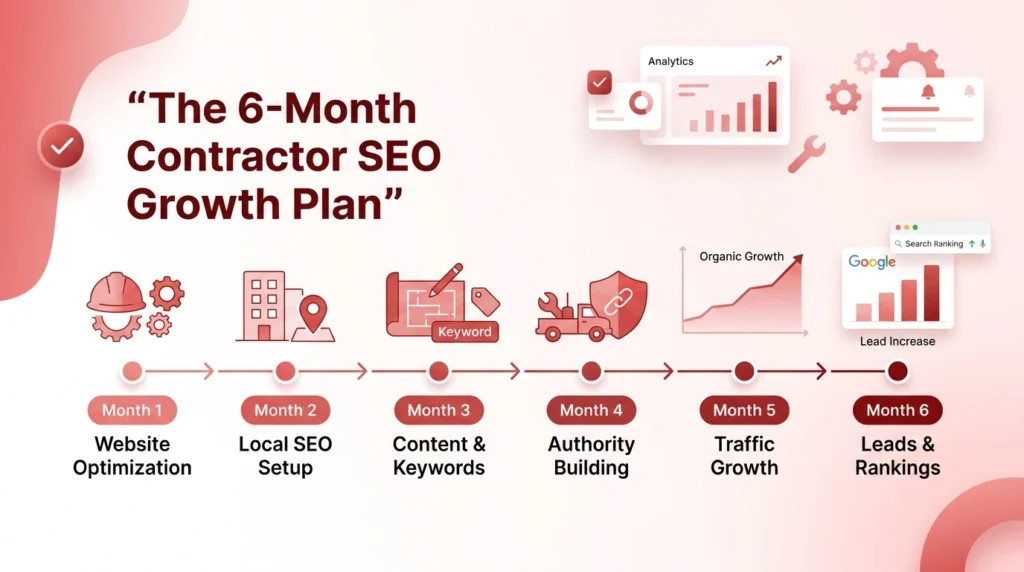
The 6-Month Contractor SEO Growth Plan
| Timeline | Primary Focus | Key Activities | Expected Outcome |
| Month 1–2 | The Foundation | Fix website errors, optimize Google Business Profile, and map out keywords. | Google starts to recognize you as a relevant local business. |
| Month 3–4 | Authority & Trust | Publish helpful content, start link building, and get more customer reviews. | Your business moves up in rankings as Google sees that people like your work. |
| Month 5–6 | Scaling & Domination | Create pages for nearby cities and focus on winning the #1 spot in the Map Pack. | You should see a steady and predictable flow of calls and leads from Google. |
Why This Timeline Matters
- SEO is a System: It is a slow and steady climb that grows through consistent work over time.
- Building Trust: Google needs clear signals and history before it moves you to the top of the search results.
- Predictable Growth: By the end of six months, your rankings turn into a lead-generation machine rather than a one-time effort.
Core Ranking Factors That Control Visibility
To master SEO for Contractors, you must balance three primary pillars:
- Relevance: This ensures you match the search query. If someone wants “roofing,” and your site is optimized for “general construction,” you might lose to a specialized roofer. Google prefers businesses that are clearly experts in a specific niche.
- Proximity: This is about distance. For urgent services like plumbing or AC repair, Google wants to show the closest pro. While you can’t change your physical location, you can optimize for the cities you serve.
- Authority: You build this through reviews, links from other local sites, and mentions in directories. Strong authority allows you to outrank competitors even in very crowded markets.
Behavioral Signals That Influence Rankings in Real Time
Modern Google algorithms are very smart. They track user behavior to decide who is “the best.” If people frequently click your listing and call you, Google sees that as a “vote” for your quality. This can improve your rank faster than almost anything else.
On the flip side, low engagement is a warning sign. If users see your listing but “bounce” back to search for someone else, your visibility will drop. This explains why some contractors with fewer reviews sometimes outrank big companies; it’s because they have higher engagement levels.
The Simple Ranking Flow
Google’s system follows a very specific path. If you break the chain at any point, the leads stop coming. The flow looks like this:
Search Intent → Visibility → Engagement → Trust → Ranking → Leads
You must optimize for every step. If you have visibility but no trust, you won’t get the click. If you have trust but no visibility, no one will find you. You must treat SEO as a full system.
The Local SEO System That Drives Leads
Local SEO is the foundation of your lead flow. Its main job is to get you into the Map Pack. This is not a one-step process. It requires multiple layers of your digital presence working together.
Google Business Profile (GBP): Your Core Engine
Your GBP is your most powerful tool. It sends constant signals to Google about your activity. To keep it running, you should:
- Post regular updates and fresh project photos.
- List every specific service you offer.
- Reply to every review, both good and bad.
An inactive profile will lose its rank. Even if your website is perfect, a “dead” GBP will block your local leads.
NAP Consistency: The Trust Builder
Your Name, Address, and Phone number (NAP) must be identical everywhere. This includes your website, Facebook, Yelp, and local directories. Google uses this to verify that you are a real, legitimate business. Inconsistent data makes you look like a risk to Google.
Service Area Expansion
You don’t have to be limited to one city. You can scale your visibility by creating “Service Area Pages.” These are specific pages on your website for different cities you serve (e.g., “Roofing in Lake Mary” and “Roofing in Heathrow”). This allows you to capture demand across a wide region without moving your office.
Keyword Strategy: Choosing Words That Convert
Keyword strategy is the “backbone” of your SEO. The goal isn’t just to get “traffic”; it’s to get “customers.” We categorize keywords into three types:
1. Service-Based Keywords (High Intent)
These are the most valuable words. They show a user is ready to hire right now.
- emergency electrical repair
- kitchen remodeling contractor
- roof leak fix
2. Location-Based Keywords (Local Reach)
These help Google connect your shop to a specific neighborhood or city.
- contractor in [City Name]
- best plumber near me
- local home builders
3. Informational Keywords (Authority)
These help you look like an expert. While they don’t always lead to an immediate call, they help your overall site rank higher.
- how much does a kitchen remodel cost
- signs you need a new roof
- how to find a good builder
SEO for Contractors is not about “tricking” Google. It is about building a solid, structured system. When your visibility, trust, and user behavior all work together, your lead flow becomes predictable. You stop chasing jobs and start choosing them. By understanding this system, you move away from messy marketing and toward real, long-term growth.
The Three Pillars of Contractor SEO
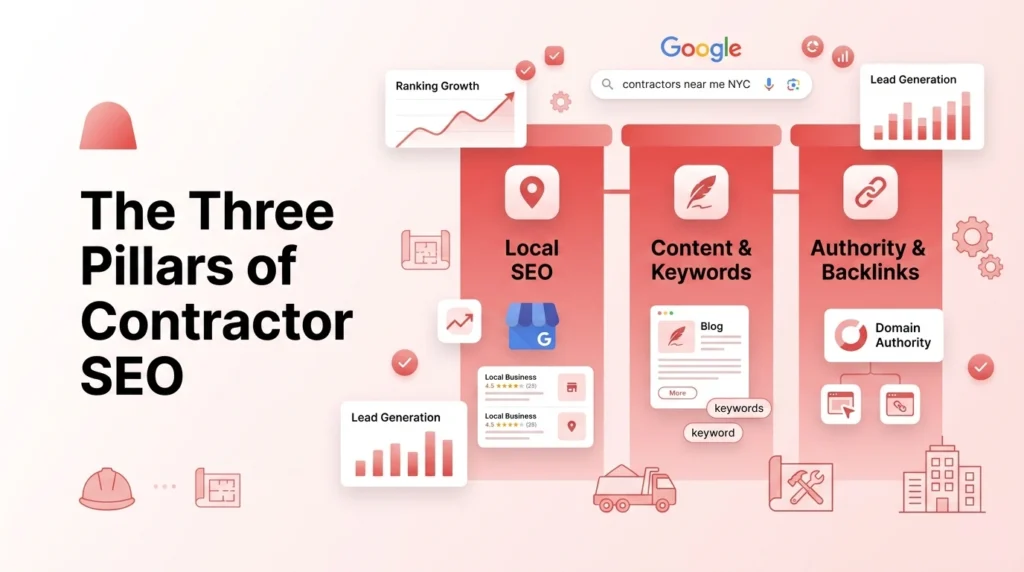
To reach the top of Google, your SEO strategy must balance three different types of optimization. Use this table to understand the purpose of each pillar.
| SEO Type | Focus Area | Goal for Your Business |
| On-Page SEO | Content & Keywords | To tell Google exactly what services you offer and where you work. |
| Off-Page SEO | Trust & Authority | To prove to Google that your business is a trusted leader in your local area. |
| Technical SEO | Speed & Performance | To ensure your website is fast, safe, and easy for Google to read. |
How These Pillars Help You Get More Leads
1. On-Page SEO: Speaking Google’s Language
On-page SEO is about the words and images on your website. By using high-intent keywords like “emergency roof repair” or “contractor in New York,” you help Google match your site to the right customers. When your pages are clear and helpful, visitors stay longer, which signals to Google that you are an expert.
2. Off-Page SEO: Building Your Reputation
Off-page SEO happens away from your website. It includes getting links from local directories and maintaining a strong Google Business Profile. Think of every backlink or positive review as a “vote” for your business. The more “votes” you have from trusted local sources, the higher Google will place you in the Map Pack.
3. Technical SEO: The Foundation of Your Site
If your website is slow or hard to use on a phone, customers will leave before they ever call you. Technical SEO fixes the “behind-the-scenes” parts of your site. It ensures your pages load fast and that your contact buttons actually work. A technically sound website builds trust and makes it easy for Google to index your new content.
Advanced SEO for Contractors: Turning Rankings Into Leads
Ranking on the first page of Google is only the first step. Many business owners think that just showing up on page one will automatically bring in new jobs. In reality, rankings by themselves do not make money. The real value happens when those rankings are part of a system, like a dedicated strategy for SEO for Contractors in New York, that turns visitors into actual customers.
Advanced SEO is not just about getting more traffic. It is about turning that traffic into predictable growth. Successful contractors in busy markets know that SEO is a system, not a one-time setup. That system is built on three main pillars: visibility, trust, and conversion.
- Visibility: This ensures your business shows up when people search.
- Trust: This convinces people that you are reliable and honest.
- Conversion: This turns a website visitor into a phone call or a lead.
If even one of these is missing, your rankings will fail to bring in steady work. This is why many contractors rank high but still struggle to get leads. Advanced SEO fixes this gap. It aligns all three parts into one structure that drives revenue.
How Contractor Websites Turn SEO Traffic Into Leads
Conversion optimization is often the most ignored part of SEO. However, it is the most important factor for making money. A website is not successful just because people visit it. It is successful because those visitors become paying customers. Most contractor websites fail because they look like digital brochures instead of lead-generating machines.
Also Read: SEO for Electricians in New York: Why Most Electricians Fail to Get Leads from Google
Why Most Contractor Websites Fail to Get Leads
The biggest problem is a lack of “conversion structure.” Even if you rank well for SEO for Contractors in New York, users might land on your site and leave in seconds. This happens because there is no clear path for them to follow. They don’t see trust signals or an easy way to contact you.
A typical user journey often looks like this:
- A user searches for a “contractor near me” on Google.
- They click on a website they see in the results.
- They do not immediately see the specific service or location they need.
- They cannot find reviews or a phone number quickly.
- They leave and click on a competitor instead.
This is a conversion problem, not a traffic problem. Users are usually in a “problem-solving” mindset. If your site doesn’t prove you can solve their problem right away, they will find someone else who can.
The Proven Framework for a High-Converting Page
A great contractor website follows a specific layout. This layout is designed to guide the user toward taking action.
1. Above the Fold (The First Impression)
This is the top part of your site that people see without scrolling. Users decide in seconds whether to stay or leave. This section must answer three questions: What do you do? Where do you work? Can I trust you?
- Clear Statement: For example, “Expert Roofing Contractor in Dallas.”
- Call Button: A big button that says “Call Now” should be visible immediately.
- Trust Badge: Show your Google rating or a professional certification right at the top.
2. The Mid-Section (Trust and Proof)
Once you have their attention, you must build their confidence.
- List of Services: Be clear about what you offer.
- Before and After Photos: Show real proof of your hard work.
- Testimonials: Let your happy customers do the talking.
3. The Bottom Section (The Conversion Layer)
This is where you push the user to act.
- Strong Call to Action: Use phrases like “Request a Free Quote” or “Call Us Today.”
- Urgency: Mention same-day service or emergency help.
- Contact Form: Keep it simple so people can reach out easily.
Trust Signals That Drive Calls
Trust is vital because home repairs are high-value decisions. People do not hire the first name they see; they hire the one they believe in. Key signals include verified reviews, licenses, and years of experience. When these are easy to see, people decide faster. In the service industry, trust is often more important than the lowest price.
The Power of Urgency Positioning
Contracting jobs are often emergencies. If someone has a leaky roof or a broken pipe, they need help right now. You can win more jobs by using “Urgency Messaging.”
- “24/7 Emergency Service Available”
- “Same-Day Support”
- “Fast Response in Hours”
When a user is in a hurry, they prioritize speed over shopping around. Sites that show they can act fast usually get the call first.
Behavioral SEO: The Hidden Ranking Factor
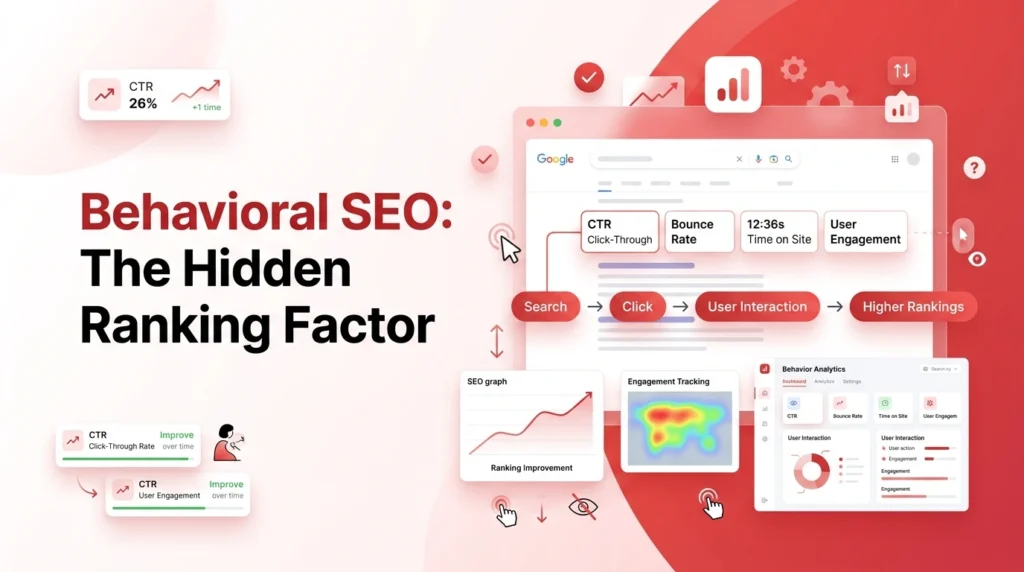
Behavioral signals are very powerful yet rarely discussed. These signals are based on how real people interact with your business after they see you on Google.
What Are Behavioral Signals?
Google watches what users do to see if your business is helpful. They track:
- Click-Through Rate (CTR): How many people click your link?
- Phone Calls: How many people call you from your Google listing?
- Direction Requests: How many people want to find your shop?
- Bounce Rate: If people leave your site immediately or stay to read.
How Behavior Impacts Your Rank
Rankings are no longer just about keywords. Google now prioritizes what people actually like. If more people engage with your business, Google will move you higher. If people ignore your listing, your rank will drop. Small changes to your titles or photos can make people click more, which helps your long-term ranking.
Advanced Google Business Profile Strategy
Your Google Business Profile (GBP) is your most powerful tool. It controls the “Map Pack” (the map at the top of search results). This is where the majority of local leads come from.
The Weekly Activity Plan
Consistency is the secret to staying on top of the map.
- Post Updates: Share 2–3 updates about your projects every week.
- New Photos: Upload 3–5 fresh job site photos weekly.
- Reply to Reviews: Always respond to every customer, whether the review is good or bad.
The Review Acquisition System
Reviews are not just “nice to have,” they are ranking signals.
- Ask for a review as soon as the job is finished.
- Send a follow-up text or email.
- Ask customers to mention the service and the city in their review. Keyword-rich reviews help you rank even better.
Competitor Gap Analysis
To win, you must see what the top 3 businesses are doing. Look at how many reviews they have and how often they post. If they post once a week, you should post three times. Identify where they are being lazy and fill that gap with your own activity.
Content and Authority Scaling
Content is not just for reading; it is a system to build your authority on Google.
The Content Clustering Model
To show Google you are an expert, use a “Clustering” system:
- Core Pages: These rank for your main services (like “Roofing Repair”).
- Supporting Blogs: These answer common questions (like “How to spot roof damage”).
- Location Pages: These help you rank in nearby cities.
This creates an “Authority Flow.” When your blogs link to your service pages, it spreads “ranking power” across your whole site.
High-ROI Content Types
Focus on content that people actually search for when they are ready to spend money:
- Cost Guides: “How much does a kitchen remodel cost in [City]?”
- Comparison Articles: “Repair vs. Replacement: Which do you need?”
- Near Me Pages: Pages optimized for your specific neighborhood.
Link Building for Contractors
Backlinks are like “votes of confidence” from other websites. When a reputable site links to yours, it tells Google that your business is a trusted authority. At Digixial, we use these links to build your digital reputation and move you to the top of search results.
- Verified Local Authority: Links from local New York organizations, like the Chamber of Commerce or local hardware stores, prove to Google that you are a legitimate, active part of the community.
- Topical Expertise: Getting mentions on construction blogs or home improvement sites tells Google you are a specialized expert, helping you outrank general competitors.
- Long-Term Lead Bridges: Unlike ads that disappear when you stop paying, a high-quality link acts as a permanent bridge that sends interested customers directly to your site for years.
The Digixial Difference: We focus on quality over quantity. One link from a trusted local supplier is worth more than 1,000 random links from unrelated sites.
Local and Industry Links
Don’t just get any links. Focus on:
- Local Directories: Join your local Chamber of Commerce.
- Sponsorships: Support a local Little League team or event.
- Industry Blogs: Get mentioned on home improvement websites.
Most contractors fail at this because they buy low-quality, random links. For a contractor, one link from a local hardware store is worth more than 100 links from random blogs.
The Cost of Contractor SEO in New York
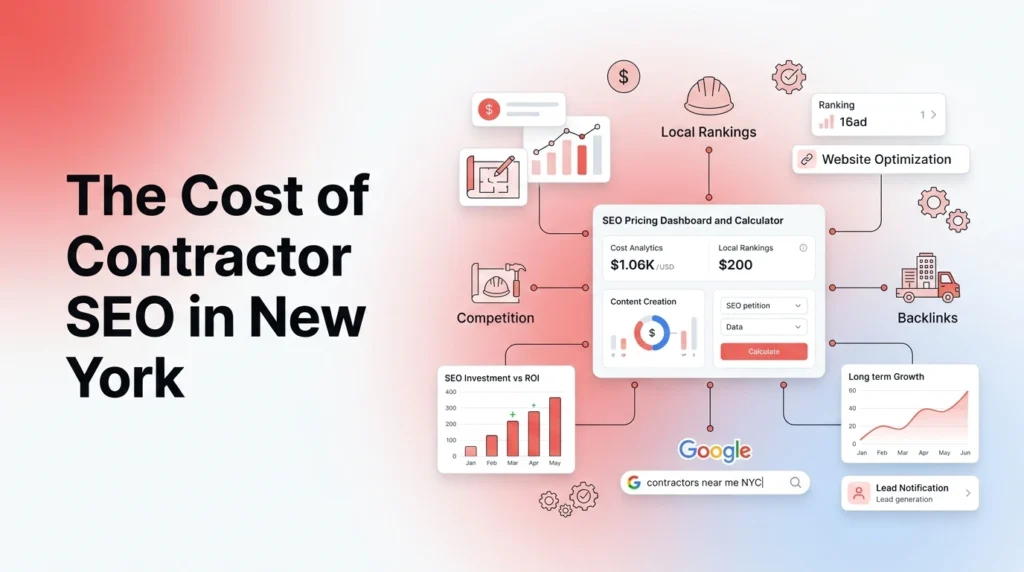
SEO is an investment in a lead-generation system. Here is a basic breakdown of what you might spend per month:
| Service Part | Monthly Cost | Why You Need It |
| GBP Optimization | $100 – $300 | To show up on Google Maps |
| Local Citations | $200 – $500 | To prove your location to Google |
| On-Page SEO | $300 – $800 | To make your website easy to read |
| Content Creation | $400 – $1,500 | To show you are an expert |
| Backlink Building | $300 – $1,000 | To build your site’s power |
| Full Management | $1,000 – $3,000+ | To handle the whole system |
Common Mistakes That Kill Rankings
Don’t let these simple errors ruin your hard work:
- Ignoring the Website: Having good Map rankings, but a website that doesn’t convert.
- Messy Info: Having different phone numbers or addresses on different sites.
- Stopping Too Soon: SEO requires ongoing activity. If you stop posting and getting reviews, your rank will fall.
- Keyword Stuffing: Writing for robots instead of real people. Google is smart enough to know the difference.
Final Thoughts
SEO for Contractors is not just a marketing trick. It is a complete business system. Those who treat it like a core part of their company will always beat the ones who treat it like an “extra” expense.
Success comes when you combine visibility, trust, and conversion. When these three things work together, your rankings turn into a predictable way to grow your business. You stop worrying about where the next job is coming from and start focusing on doing great work.
FAQs
What is SEO for Contractors?
SEO for Contractors is the process of optimizing a contractor’s online presence to improve visibility in Google search results and generate more local leads. It includes local SEO, Google Business Profile optimization, service pages, keyword targeting, content creation, backlinks, and conversion optimization. The goal is to help contractors appear when potential customers search for services like roofing, remodeling, plumbing, or electrical work in their area.
Why is SEO important for contractors?
SEO is important because most customers now search online before hiring a contractor. If your business does not appear in Google search results or the Map Pack, potential leads usually go to competitors instead. Strong SEO increases visibility, trust, and phone calls while reducing dependence on referrals or paid ads.
How long does SEO for Contractors take to show results?
Most contractor businesses begin seeing early improvements within 2 to 3 months, while stronger ranking growth usually happens between 4 and 6 months. The timeline depends on competition, website quality, local SEO setup, backlinks, and Google Business Profile activity. Consistent optimization produces better long-term results.
How does Google Business Profile help contractors rank higher?
Google Business Profile helps contractors appear in the local Map Pack, which generates a large percentage of local service leads. An optimized profile with updated services, photos, reviews, and regular activity sends strong trust and relevance signals to Google, improving visibility in local searches.
How do reviews impact contractor SEO rankings?
Reviews act as trust and engagement signals in local SEO. Businesses with more positive and recent reviews usually gain stronger visibility because Google sees them as more trustworthy and active. Reviews that naturally mention services and locations can also strengthen local relevance signals.
What is the difference between local SEO and traditional SEO for contractors?
Traditional SEO mainly focuses on improving website rankings globally or nationally, while local SEO focuses on appearing in location-based searches and Google Maps results. Contractors rely heavily on local SEO because customers usually search for nearby service providers instead of businesses in other cities or states.
How often should contractors update their SEO strategy?
SEO should be updated continuously because Google rankings constantly change based on competition, algorithm updates, and user behavior. Consistent activity helps maintain and improve search visibility over time.
Are backlinks important for contractor SEO?
Yes, backlinks remain one of the strongest authority signals in SEO for Contractors. Links from local directories, construction blogs, home improvement websites, and trusted local businesses help improve credibility and ranking strength. High-quality and relevant backlinks are far more valuable than random low-quality links.
How does conversion optimization improve contractor SEO performance?
Conversion optimization improves the percentage of visitors who become leads. Google also tracks user engagement signals like clicks, calls, and time spent on the website. When users interact positively with a contractor’s website, rankings can improve because Google sees the business as more relevant and useful.