
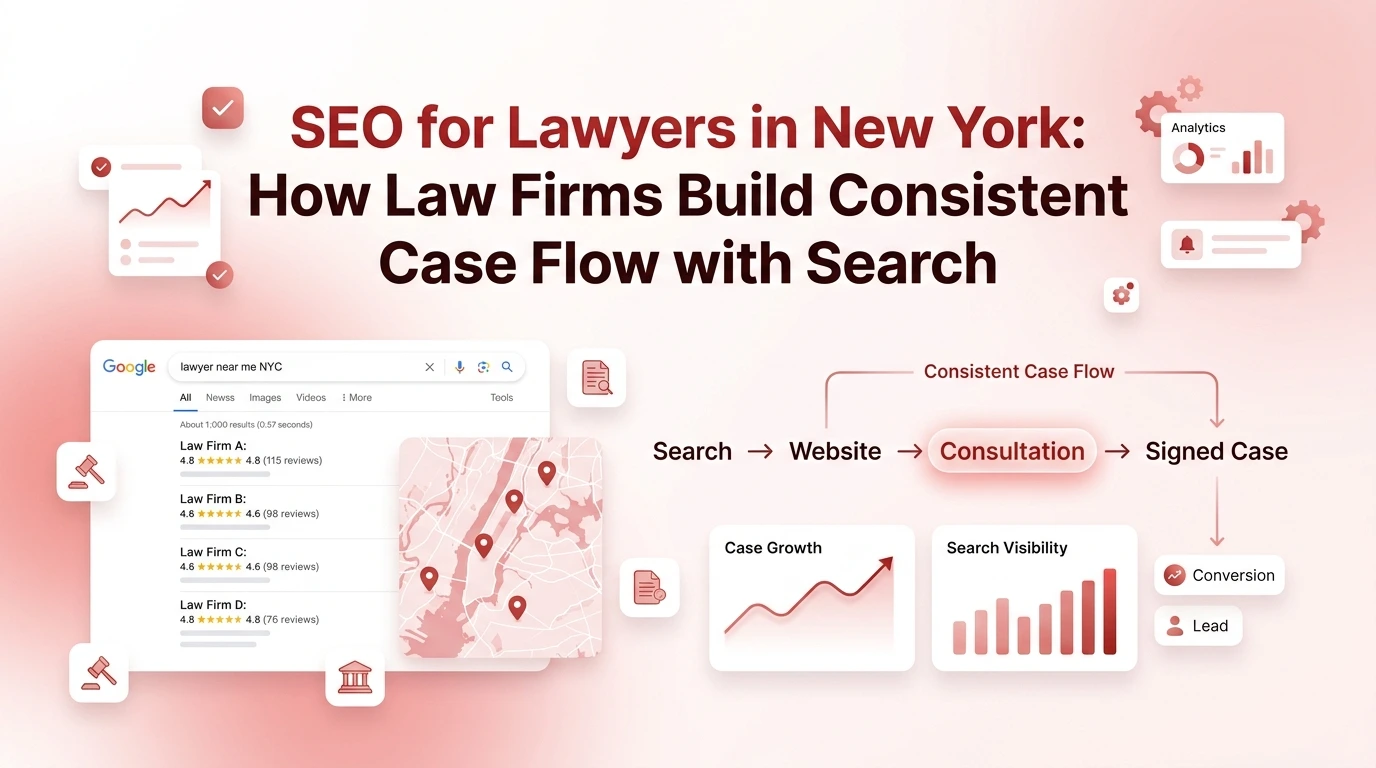
SEO for lawyers is a structured case acquisition system that connects law firms with clients who are actively searching for legal help on Google. In a market like New York, where competition is high across every legal category, visibility is not optional. It determines whether a firm receives inquiries or loses them to competitors.
Most legal clients do not explore options for long periods. They search, scan results, check reviews, and make decisions quickly. This behavior creates a high-intent environment where ranking position directly influences case flow. A firm that appears in the top results captures demand. A firm that does not appear remains invisible, regardless of experience.
Legal services also carry high transaction value. A single personal injury or corporate case can generate significant revenue. This changes SEO from a marketing activity into a long-term revenue system. When implemented correctly, it produces consistent inbound inquiries without relying on paid advertising.
What Is SEO for Lawyers and Why It Works Differently in Legal Markets
SEO for lawyers is the process of optimizing a law firm’s digital presence to rank for legal searches with clear intent. It includes website optimization, content strategy, local SEO, and authority development. However, legal SEO operates under stricter evaluation standards compared to general industries.
Google treats legal services as a high-trust category. This means rankings depend not only on keyword relevance but also on credibility signals. These include reviews, backlinks from authoritative sources, consistent business data, and strong content depth. A law firm with weak trust signals struggles to rank even with optimized content.
Another key difference is intent intensity. Legal searches often come from users who need immediate solutions. Queries such as “personal injury lawyer NYC” or “criminal defense attorney near me” indicate direct hiring intent. SEO in this space focuses on capturing these moments and converting them into consultations.
How SEO for Attorneys Works as a Multi-Layer Case Acquisition System
SEO for attorneys operates as a connected system where each layer supports the next. It is not a single tactic but a sequence of processes that move a user from search to consultation.
1. Demand Capture (Search Intent Layer)
Law firms target keywords that reflect real legal needs. These include service-based, urgency-based, and location-specific queries. Without accurate intent targeting, traffic does not convert into cases.
2. Visibility Layer (Ranking System)
The website and Google Business Profile gain visibility in search results and map listings. In New York, top positions receive the majority of clicks, especially on mobile devices.
3. Trust Layer (Credibility Signals)
Users evaluate reviews, website quality, and perceived authority within seconds. Google also measures trust through backlinks, citations, and engagement signals.
4. Conversion Layer (Client Action System)
Clear contact paths, strong messaging, and structured pages convert visitors into inquiries. This includes call buttons, consultation forms, and persuasive service explanations.
If any layer is weak, the system breaks. High rankings without trust reduce conversions. Strong trust without visibility limits reach.
Why SEO Marketing for Lawyers Is Critical in New York
New York represents one of the most competitive legal markets in the United States. Every practice area has dense competition, from personal injury and family law to immigration and corporate services.
Clients searching for legal help in this market are highly selective. They compare firms quickly based on three primary signals: ranking position, reviews, and perceived expertise. Most decisions happen within the first page of search results. Firms outside these positions rarely receive consistent inquiries.
Paid advertising can generate leads, but costs are high and increase over time. Legal keywords often carry some of the highest cost-per-click rates. Once ad spending stops, lead flow stops as well. SEO provides a different model. It builds visibility that continues to generate inquiries over time.
In a competitive city, SEO is not a growth option. It is a requirement for stable case acquisition.
How Clients Search for Legal Services (Intent and Behavior Analysis)
Client search behavior follows a clear pattern based on urgency and location. Most users search on mobile devices and expect immediate results.
High-intent queries usually combine service type and location. Examples include:
- personal injury lawyer NYC
- divorce attorney Manhattan
- immigration lawyer Brooklyn
- criminal defense lawyer near me
These searches indicate readiness to hire. Users are not researching broadly. They are evaluating options quickly. They focus on firms that appear credible and accessible.
Decision-making happens within seconds. Users scan reviews, check ratings, and evaluate website clarity. If a firm does not provide clear information or trust signals, the user moves to the next option.
This behavior makes SEO both a visibility and conversion system. Ranking alone is not enough. The entire user experience must support decision-making.
High-Intent Keyword Strategy for Law Firm SEO (Revenue-Focused Targeting)
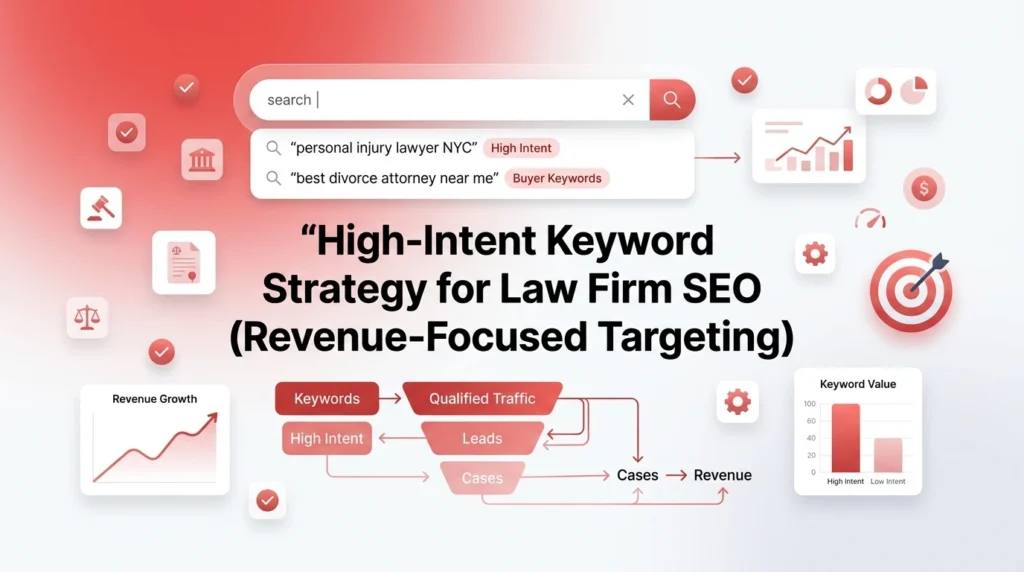
Keyword strategy determines how effectively a law firm captures demand. High-intent keywords generate the most valuable traffic because they reflect immediate legal needs.
Keyword Intent Structure
| Keyword Type | Example | Intent Level | Business Value |
| Service + Location | personal injury lawyer NYC | Very High | Direct case inquiries |
| Urgency-Based | accident lawyer near me | Very High | Immediate conversions |
| Practice-Specific | divorce attorney Manhattan | High | Consistent demand |
| Cost-Based | affordable lawyer Brooklyn | High | Price-sensitive clients |
| Informational | What to do after an accident | Medium | Early-stage awareness |
High-intent keywords should map directly to service pages. Informational keywords support authority and capture early-stage users.
A structured keyword system improves both rankings and conversion rates. Without it, traffic remains unfocused and low-value.
SEO Services for Lawyers: Core Execution Framework
SEO services for lawyers involve multiple components that must work together. Isolated optimization does not produce consistent results.
Service Page Development (Primary Revenue Drivers)
Each legal service requires a dedicated page. This allows search engines to match specific queries with relevant content.
Examples include:
- personal injury lawyer page
- family law attorney page
- criminal defense lawyer page
Each page must explain the legal process, expected outcomes, and client benefits. It should also include location signals and strong calls to action.
Local SEO for Lawyers (Map Visibility System)
Local SEO determines how often a firm appears in Google Maps and local search results. This area generates a significant portion of legal leads.
Key elements include:
- Google Business Profile optimization
- consistent business information across directories
- review acquisition and response strategy
- accurate service categories
Strong local SEO improves both visibility and trust.
Authority Building (Ranking Stability Factor)
Authority signals influence how search engines evaluate a law firm’s credibility. These include backlinks, citations, and brand mentions.
Effective sources include:
- legal directories
- local business listings
- industry publications
- media coverage
Authority building requires consistency. It strengthens ranking potential over time.
Conversion Optimization (Case Generation Layer)
Traffic has no value if it does not convert. A law firm website must guide users toward action.
Important elements include:
- clear consultation offers
- visible contact options
- client testimonials
- trust indicators such as certifications and case results
A structured conversion system increases inquiry rates and improves ROI.
Local SEO for Lawyers in New York (Google Maps Dominance Strategy)
Local SEO is the most powerful driver of leads for law firms. Google Maps listings often appear above organic results, making them a primary conversion channel.
To rank effectively, firms must optimize multiple factors:
- complete and accurate Google Business Profile
- consistent citations across directories
- high-quality and frequent client reviews
- regular profile updates and activity
Google evaluates three main signals:
Relevance: How closely the business matches the search query.
Distance: How near the firm is to the searcher?
Prominence: How well-known and trusted the firm is online.
Prominence depends on review volume, backlink quality, and brand visibility. Firms that strengthen all three signals consistently rank higher in local results.
Website Structure for SEO for a Lawyer (Ranking Foundation)
A law firm website must follow a structured architecture to perform effectively in search results.
Core Components
Service Pages: Each legal service targets a specific keyword and intent.
Location Pages: Pages target different areas such as Manhattan, Brooklyn, Queens, and the Bronx.
Supporting Content: Blogs and guides build authority and support service pages.
Internal linking connects these pages into a unified system. This improves crawlability and keyword relevance across the website. Without this structure, search engines cannot clearly understand the firm’s expertise.
Technical SEO for Law Firm Websites (Performance Layer)
Technical SEO ensures that a website functions efficiently for both users and search engines.
Key factors include:
- fast loading speed
- mobile responsiveness
- secure HTTPS protocol
- clean navigation structure
- proper indexing and crawlability
In competitive markets, technical issues reduce ranking potential. Even strong content cannot perform well on a poorly optimized website.
A solid technical foundation supports long-term SEO growth.
Why Many Law Firms Fail with SEO (System Gaps Analysis)
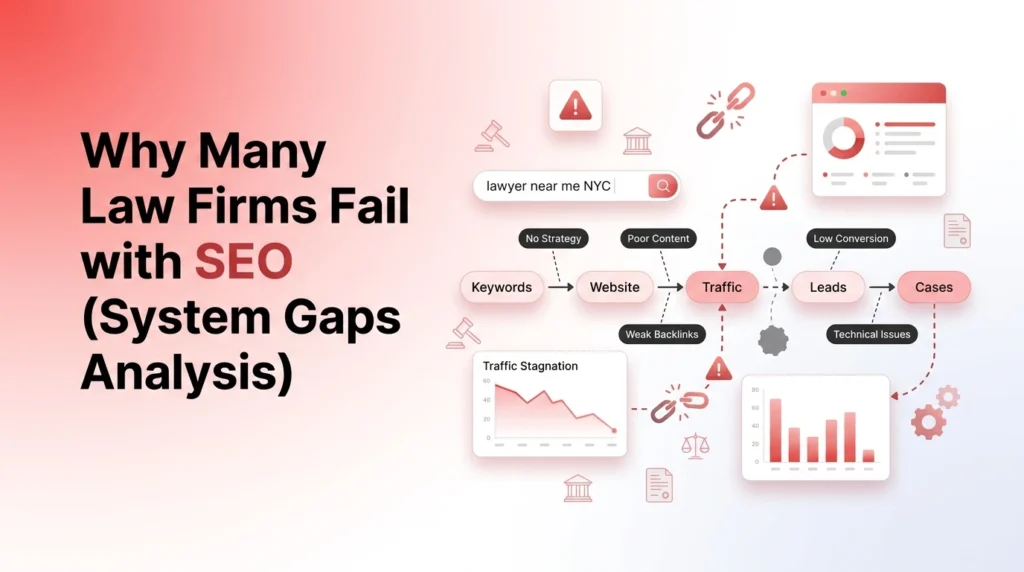
Most law firms do not fail because of competition. They fail due to incomplete execution of SEO systems.
Common issues include:
- lack of dedicated service pages
- weak Google Business Profile optimization
- low review volume and activity
- poor keyword targeting
- absence of structured content strategy
These gaps prevent firms from achieving consistent visibility and case flow. SEO success requires full system implementation. Partial efforts lead to unstable results.
Also Read: SEO for Dentists in New York: Get More Patients Using Google’s Power
Service Area SEO for Lawyers in New York (Geo-Authority Expansion Layer)
Service-area SEO is a critical ranking factor for law firms in New York because legal clients search with location intent. Most users do not search broadly. They search within boroughs, neighborhoods, or nearby legal service zones.
Google evaluates law firms on both overall authority and geographic relevance. A firm targeting only “New York” often underperforms compared to firms that build structured visibility across multiple locations.
A strong service area SEO system connects legal services with geographic signals in a structured way. This improves both organic rankings and Google Maps performance.
Instead of treating location as a single keyword, it becomes a layered system where practice areas and locations work together.
For example:
- Personal injury + Manhattan searches
- Criminal defense + Brooklyn intent
- Family law + Queens legal demand patterns
This alignment improves how Google understands relevance across different regions.
A properly structured service area SEO system includes several core elements:
- Each borough or region is supported with location-relevant content signals
- Legal services are mapped to specific geographic search behavior
- Content reflects real differences in client demand across locations
- Internal linking connects service pages with location-based relevance
- Google Business Profile performance is reinforced through consistent geographic signals
Another important factor is content uniqueness across service areas. Many law firms make the mistake of duplicating identical pages for each location. Google interprets this as low-value repetition, which weakens rankings instead of improving them.
Service area SEO also strengthens local map rankings. When Google sees consistent alignment between website content and geographic search intent, it increases visibility in the local pack results. This directly impacts lead flow because most legal clicks come from map listings rather than standard organic results.
Advanced SEO Strategy for Law Firms in New York
Advanced SEO for lawyers is not built on basic keyword targeting. In a competitive legal market like New York, ranking requires structured authority building across search intent layers, legal categories, and trust signals.
Google evaluates law firm websites differently compared to normal businesses because legal search queries fall under high-trust categories. This means ranking depends heavily on credibility, not just content volume.
A strong law firm SEO system is built on three interconnected layers:
The first layer focuses on legal service relevance, where each practice area must be clearly defined and separated. Personal injury, criminal defense, immigration law, and family law all require individual SEO structures because user intent differs significantly.
The second layer is local authority strength, which comes from Google Business Profile optimization, local citations, and location-based relevance signals. In New York, borough-level targeting becomes critical because users often search within Manhattan, Brooklyn, Queens, or the Bronx instead of generic city-wide queries.
The third layer is trust engineering, which includes attorney profiles, case experience signals, reviews, and legal content depth. Without this, even well-optimized pages struggle to rank in competitive SERPs.
When all three layers work together, a law firm begins to establish topical dominance instead of isolated keyword rankings.
SEO Pricing for Lawyers and Law Firms in New York
SEO pricing in the legal industry is significantly higher compared to most service businesses because competition is intense and keyword value is extremely high.
Law-related keywords such as “personal injury lawyer NYC” or “criminal defense attorney New York” can cost hundreds of dollars per click in paid advertising. This makes SEO a more cost-efficient long-term acquisition channel, but it also increases execution difficulty.
In New York, law firm SEO pricing generally follows three tiers:
Entry-level SEO systems typically focus on a single practice area and limited local optimization. This includes basic on-page SEO, Google Business setup, and minimal content development.
Growth-level SEO systems expand into multi-page practice area structuring, local landing pages, and consistent content production. This is where most law firms start seeing stable lead flow.
Advanced SEO systems operate at full scale, covering multiple legal categories, borough targeting, authority backlink building, and conversion optimization. This level is designed for competitive firms aiming for dominance in search results.
The actual cost varies depending on competition level, number of attorneys, and practice areas being targeted. However, legal SEO should always be viewed as a revenue investment rather than a marketing expense because a single case can often justify months of SEO investment.
Local SEO for Lawyers in New York (High-Impact Ranking System)
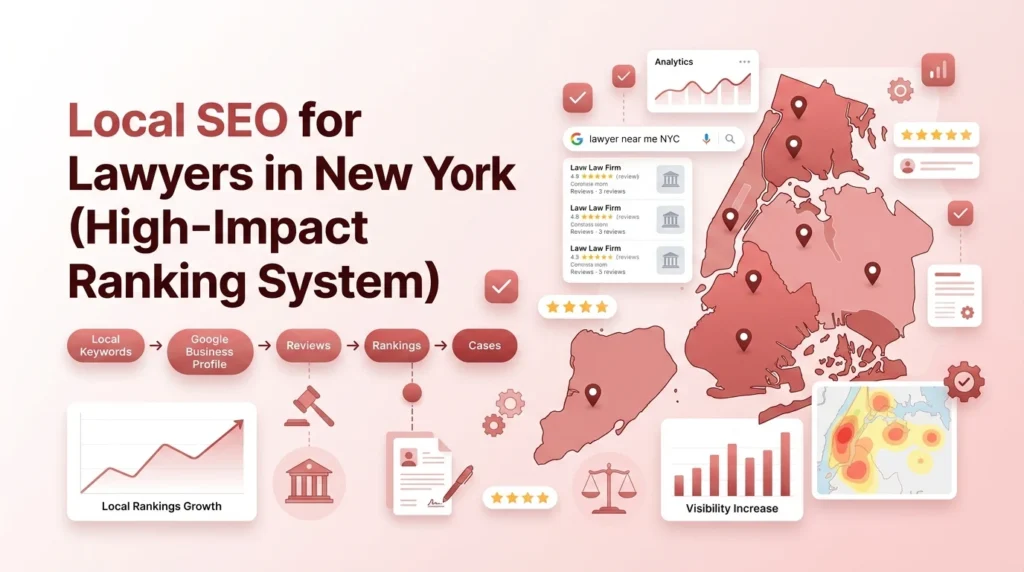
Local SEO is the strongest acquisition channel for law firms because most legal searches include location-based intent.
When someone searches “lawyer near me” or “divorce attorney Brooklyn,” Google prioritizes proximity, relevance, and trust signals before anything else.
In New York, local SEO becomes more complex due to dense competition. Ranking depends heavily on Google Business Profile strength, review velocity, and local authority signals.
A properly optimized law firm local SEO system includes accurate business category selection, consistent NAP data across directories, and frequent profile updates. However, these are only foundational elements.
Advanced local SEO focuses on behavioral signals. This includes how users interact with listings, how often profiles receive engagement, and how consistently reviews are generated over time.
Another critical factor is borough-based optimization. A law firm targeting New York cannot rely on a single page or listing. Separate local signals must be built for Manhattan, Brooklyn, Queens, and other regions to maximize visibility coverage.
SEO Marketing for Lawyers and Law Firms
SEO marketing for lawyers is not about content publishing alone. It is about building structured authority across search intent stages.
Most legal clients go through a predictable decision journey. First, they search for symptoms or legal problems. Then they compare attorneys based on credibility, experience, and reviews. Finally, they select a lawyer who appears trustworthy and accessible.
SEO must influence every stage of this journey.
Informational content captures early awareness searches like legal rights, case outcomes, or process explanations. Service pages target direct intent, such as hiring a lawyer. Trust signals like testimonials and attorney profiles support decision-making.
When these layers are aligned, SEO becomes a full legal acquisition system rather than isolated traffic generation.
SEO Services for Lawyers (What a Complete System Includes)
Professional SEO services for lawyers are structured around four major execution pillars.
The first pillar is technical SEO, which ensures the website is fast, mobile-optimized, and structured correctly for search engines.
The second pillar is content architecture, where each legal service is broken into dedicated pages supported by informational content clusters.
The third pillar is local SEO, focused on Google Business optimization, citations, and geo-targeting.
The fourth pillar is authority building, which includes backlinks, PR mentions, and legal directory placements.
Without all four pillars working together, SEO performance remains inconsistent in competitive legal markets.
Law Firm SEO Agency Model (How Agencies Actually Deliver Results)
A law firm SEO agency does not operate like a general marketing service provider. The execution model is built around legal intent mapping.
First, agencies identify high-value practice areas and prioritize them based on revenue potential. Personal injury, criminal defense, and immigration usually receive priority due to high case value.
Next, agencies build structured landing pages for each practice area. These pages are not generic descriptions but conversion-focused legal assets designed to rank and convert simultaneously.
After that, agencies focus on authority expansion through backlinks from legal directories, news mentions, and local citations.
Finally, conversion optimization is applied to ensure website traffic turns into consultation requests. This includes call tracking, intake forms, and trust reinforcement sections.
Best Law Firm SEO Companies (What Actually Defines Quality)
The “best SEO company for lawyers” is not defined by promises or rankings guarantees. It is defined by system depth.
- High-performing law firm SEO companies typically show three traits.
- They understand legal intent structure and how users search for legal help under urgent conditions.
- They build multi-layered content ecosystems instead of isolated blog posts.
- They focus heavily on local SEO dominance instead of general organic traffic.
If an SEO provider does not structure work around legal practice areas and local intent behavior, performance will always remain limited in competitive cities like New York.
SEO for Attorneys vs General SEO (Critical Difference)
SEO for attorneys is fundamentally different from standard SEO because the stakes are higher and trust requirements are stricter.
Google applies stronger E-E-A-T standards to legal content. This means authority, experience, and credibility signals are weighted more heavily than in other industries.
Legal content must demonstrate real expertise, structured explanation, and compliance-aware information framing.
Unlike eCommerce or service SEO, legal SEO is not just about ranking. It is about proving legitimacy in a high-trust environment.
SEO Website Structure for Law Firms
A law firm website must be structured around intent-based navigation rather than generic service listings.
Each practice area should function as a standalone authority page. These pages must be supported by internal linking from related informational content.
For example, a personal injury page should connect to accident guides, case outcome articles, and legal rights explanations.
This structure helps search engines understand topical depth while improving user navigation toward consultation pages.
Why Law Firm SEO Fails in Competitive Markets
Most law firms fail in SEO not because of a lack of effort, but because of incomplete system execution.
A common issue is treating SEO as content publishing instead of authority building. Without structured backlinks, citation consistency, and local optimization, rankings remain unstable.
Another failure point is weak conversion design. Even when traffic is generated, users do not convert due to a lack of trust signals or unclear consultation pathways.
Finally, many law firms ignore search intent segmentation. Users searching for legal information are treated the same as users ready to hire, which breaks conversion flow.
Final Thoughts: SEO for Lawyers as a Legal Growth System
SEO for lawyers in New York operates as a structured legal growth system rather than a marketing channel.
When executed properly, it connects search visibility, legal authority, and client conversion into a single system.
The strongest law firms in competitive markets are not always the largest. They are the ones with the most structured SEO architecture aligned with real legal search behavior.
This system ensures consistent client acquisition, reduces dependency on paid advertising, and builds long-term digital authority in the legal space by Digixial.
FAQs
How much does SEO for lawyers cost in New York?
SEO pricing for law firms in New York typically ranges from mid-level monthly retainers to high-end enterprise systems, depending on competition and practice areas. Personal injury and criminal defense usually require a higher investment due to competitive search volume and CPC value in paid ads.
How long does it take before a law firm starts getting client inquiries from SEO?
Most law firms begin seeing early movement in rankings within 3 to 4 months. However, consistent client inquiries usually develop between 4 and 8 months, depending on competition, website authority, and local SEO strength.
What results should a law firm realistically expect from SEO?
Expected outcomes include improved Google Maps visibility, higher rankings for practice area keywords, and consistent inbound consultation requests. Results vary by market competitiveness and execution quality, not just service duration.
Do SEO agencies guarantee first-page rankings for lawyers?
No professional SEO agency can guarantee rankings because Google’s algorithm changes constantly and depends on competition levels. Reliable agencies focus on improving visibility, authority, and lead generation instead of fixed ranking promises.
What do SEO agencies actually do for law firms month to month?
SEO agencies typically handle technical optimization, content development for practice areas, Google Business Profile management, backlink acquisition, and ongoing local SEO improvements based on ranking performance and search trends.
How do I know if SEO leads for lawyers are high quality?
High-quality SEO leads usually come from practice-specific searches such as “personal injury lawyer near me” or “criminal defense attorney NYC.” These users already have the intent to hire, not just browse information.
Should a law firm invest in SEO or paid ads first?
SEO is generally preferred for long-term stability, while paid ads generate immediate visibility. Many law firms combine both, but SEO becomes more cost-efficient over time as rankings generate consistent organic leads.
What makes one law firm SEO agency better than another?
The strongest agencies focus on a legal-specific SEO strategy, including practice area structuring, local search dominance, and conversion-focused website optimization. Generic SEO providers usually lack legal intent understanding.
How many leads can a law firm expect from SEO monthly?
Lead volume depends on competition, practice area, and ranking strength. In competitive markets like New York, established SEO systems can generate consistent monthly consultation requests once rankings stabilize.
Can SEO help small law firms compete with large legal firms?
Yes. SEO levels the competition field because Google prioritizes relevance, authority signals, and local optimization. Smaller firms often outperform larger firms when SEO is executed with strong local targeting and structured content.